Sport – and particularly football – remains a huge draw for television audiences around the world. The appetite for live action continues to grow.
The Slovak First Football League has been comprehensively televised since its foundation in 1993. In 2025, the football authorities forged an agreement with Slovakian public television to extend coverage. For the first time there would be live broadcasts of 2. Liga (made up of 16 teams) and 3. Liga, which has four geographic divisions and a total of 66 teams.
With the agreement only finalized in the summer, getting television production facilities ready for the start of the season in the autumn was a challenge. The work was handed to independent companies like 4 Production, which already had extensive broadcast experience in national indoor sports like top-tier handball, basketball and volleyball.
The Challenge
A big part of the challenge in setting up the coverage was that, while the First League grounds all had high capacity fiber for contribution circuits to the broadcaster in Bratislava, connectivity was much less advanced at the lower league grounds. Engineers had to develop strategies for reliable contribution links using what connectivity was available.
Juraj Sramek of Sunteq, Intinor’s partner in Slovakia, said “The speed of this project was the real challenge – just two months from final contract signing to the first games. So we needed a proven, reliable and stable technology.
The Solution
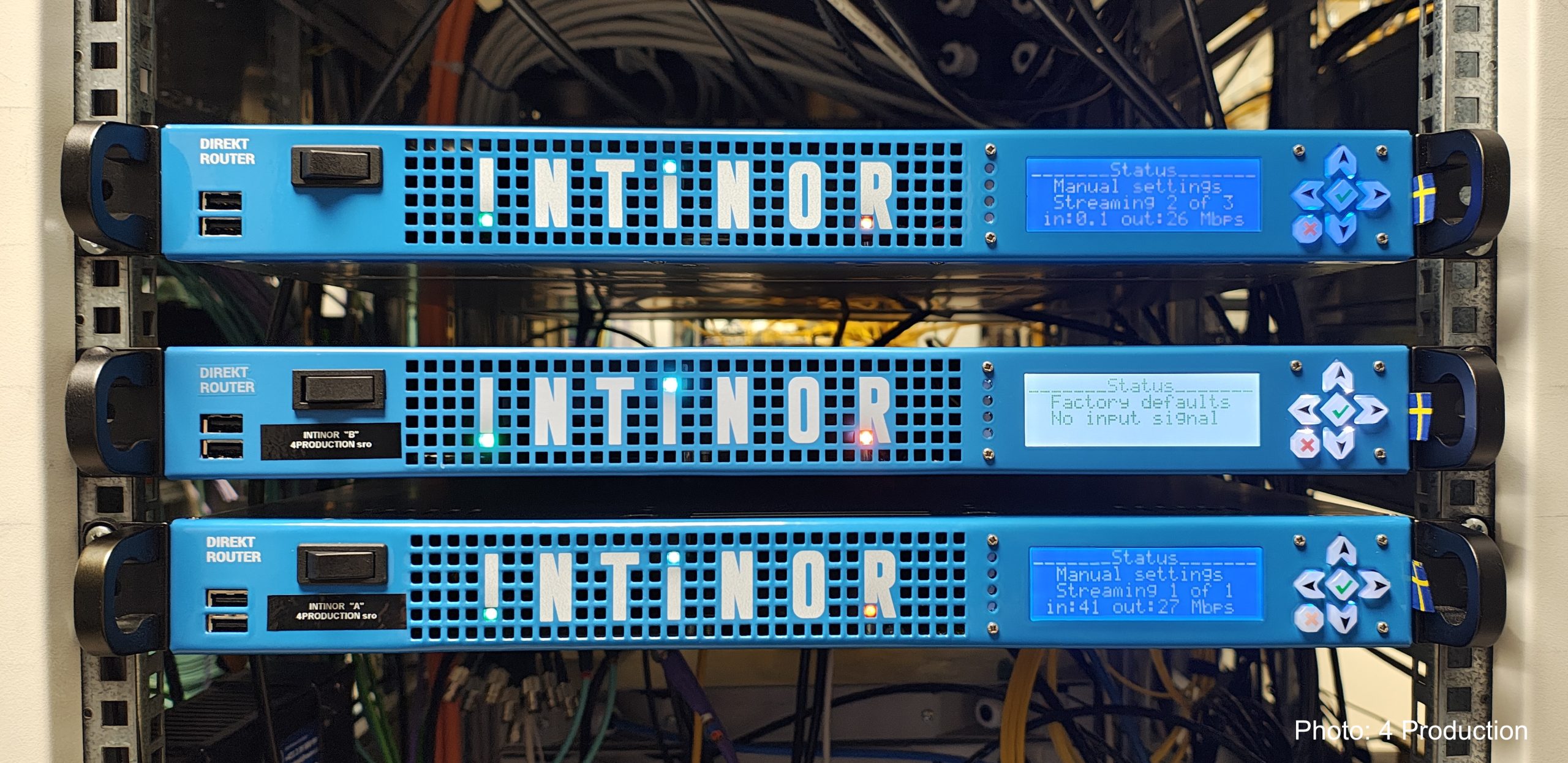
Through its experience in other sports, 4 Production had already been using Intinor Direkt routers for two years. Before adopting Intinor, the company relied on less advanced encoders, but upgraded to Direkt products to take advantage of Intinor’s enhanced reliability and performance.
The national broadcaster also had experience of Direkt, particularly for SRT ingest. In the summer of 2024, they successfully used Intinor for temporary connections between Paris and Bratislava to facilitate a major global sporting event. The technology had a great number of advantages in this application.
“Every party had experience with Intinor, and was confident in the technology,” Sramek said. “It is widely used and well proven. And Intinor delivered the units for the outside broadcast trucks within a week.”
The Result
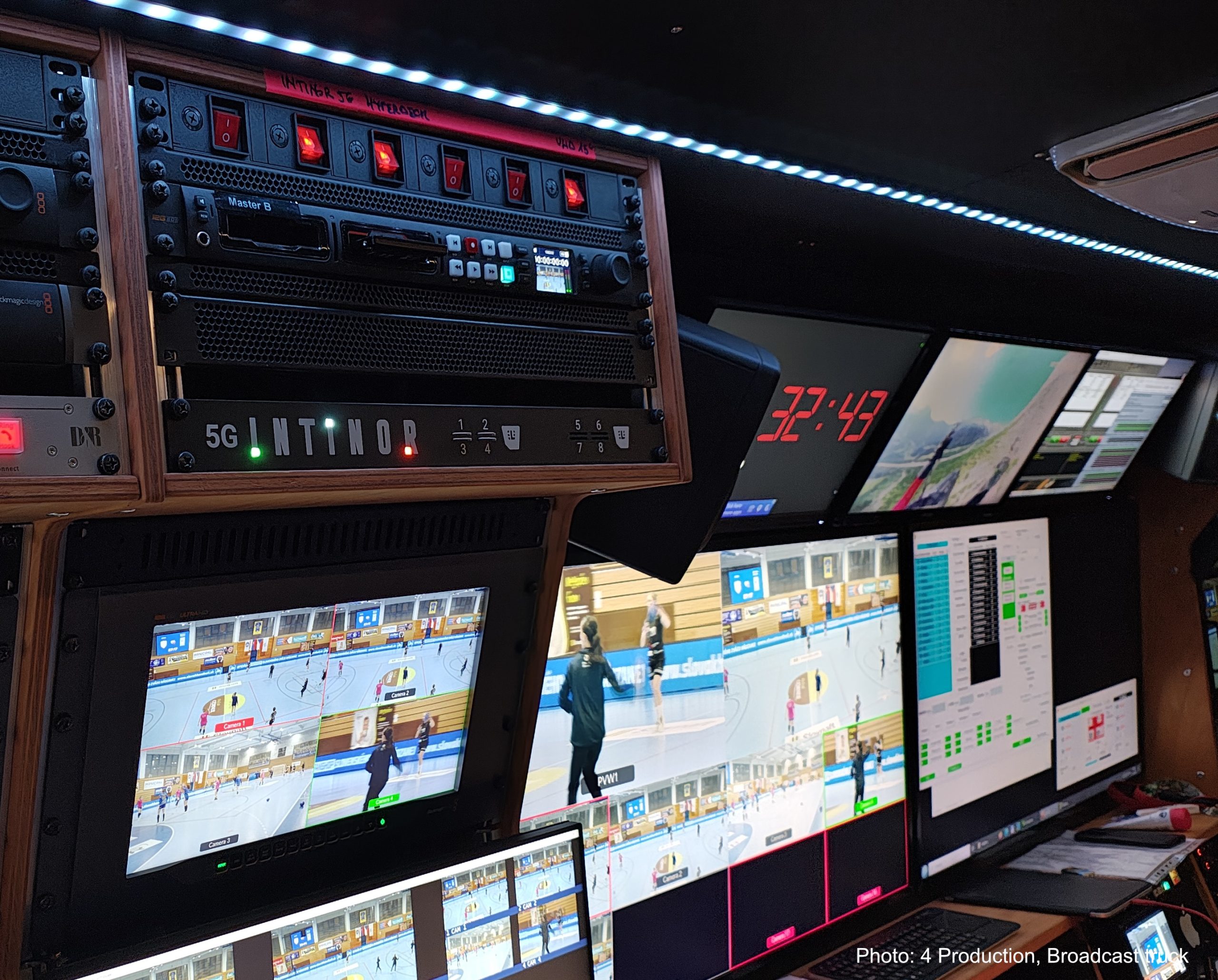
The games are produced by outside broadcast trucks which are sent to each ground. The output carried by Intinor Direkt is either the finished program, or where bandwidth is available two streams – a clean feed and the full program including graphics – using a two-stream Direkt router.
A key advantage of the Intinor approach is its unique, bespoke transport protocol Bifrost. This is designed for high-value video over the internet and incorporates particularly powerful forward error correction for maximum stability and resilience.
As an open transport layer, Bifrost can carry any codec to suit the production’s needs. At present, the football games are returned using AVC, although HEVC is readily available and can be switched on at any time.
It is also designed with network bonding in mind, and this is vital to the success of a project of this kind. Typically, the contribution feed from the outside broadcast truck at the football ground to the broadcaster would go to an Intinor Direkt router, to be carried over available cellular (4G and 5G) and broadband capacity. Thanks to Bifrost, the signal is delivered in the best possible resolution, using adaptive bitrate and bonding, and managed for least cost.
This architecture also delivers low latency, because it is a point-to-point service. It is not routed through a cloud server, which adds cost as well as latency. This ensures the operator is in full control of the delivery, helping guarantee a stable, high quality experience for viewers.
“Network bonding is what makes this work, spreading the stream across multiple mobile networks – from multiple operators – plus any fixed internet available. Bifrost ensures low latency and the best possible quality even with limited bandwidth. Direkt maintains connection very well, and everyone is very happy with the picture quality.” Juraj Sramek of Sunteq